
World Studies Interdisciplinary Project
WSIP is an international research collective of scholars devoted to decolonial paradigm-rethinking within a longue-durée framework and guided by interdisciplinary, intersectional methods. The WSIP collective is co-coordinated by Professors Mwangi wa Gῖthῖnji (Economics) and Laura Doyle (English) at the University of Massachusetts-Amherst, with support from the Mellon Foundation. Together with Professor Simon Gikandi, Professors Doyle and Mwangi wa Gῖthῖnji are currently preparing an edited collection on decolonial global studies. For contact information and fuller description of our collective project, see the bottom of this page.
To develop our research, we’ve hosted several collaborative events at UMass-Amherst while members have also co-edited publications and organized panels at inter/national conferences. Our Fall 2012 seminar-conference on “Empires, Economy, and Culture before and after 1500: Implications for Global and Postcolonial Studies” was followed in Fall 2013 by a series of linked panels at the “Rethinking Marxism” conference at UMass-Amherst. In 2015-16, with generous funding from the Mellon Foundation, we hosted a Sawyer Seminar, “Beyond Medieval and Modern: Rethinking Global Paradigms of Political Economy and Culture” (see Sawyer events). And in 2018 we held a collaborative workshop-conference, “Decolonial Reconstellations” (see Reconstellations events). The Sawyer year included “Emergent Frameworks” panels, public lectures by Ngũgĩ wa Thiong’o and Ann Stoler, and four think-tank seminar sessions, which several participants considered “one of the most inspiring scholarly meetings” they’d ever attended. See conversations with Sawyer scholars of Critical World History and IR on the nature and value of interdisciplinary decolonial research: Professors Siba Grovogui, Kenneth Pomeranz, Pinar Bilgin, Eric Tagliocozzo, and Jordan Branch.
In October 2021, Professors Laura Doyle and Mwangi wa Gĩthĩnji were awarded a $500,000 grant from The Andrew W. Mellon Foundation to create a Mellon Fellows Program and a Graduate Certificate Program in Decolonial Global Studies (DGS) at UMass Amherst. To be conceived and taught by a team of scholars across the UMass Amherst College of Humanities and Fine Arts (HFA) and College of Social and Behavioral Sciences (SBS), the DGS certificate program will also nurture the diversity of UMass faculty and graduate students by fostering an interdisciplinary intellectual community for intersectional, indigenous, decolonial and race studies scholars.
There’s more to come as we work on future conferences and an expanded website. We thank the Mellon Foundation and the University of Massachusetts-Amherst for their invaluable support of our effort to build an interdisciplinary, decolonial world studies.
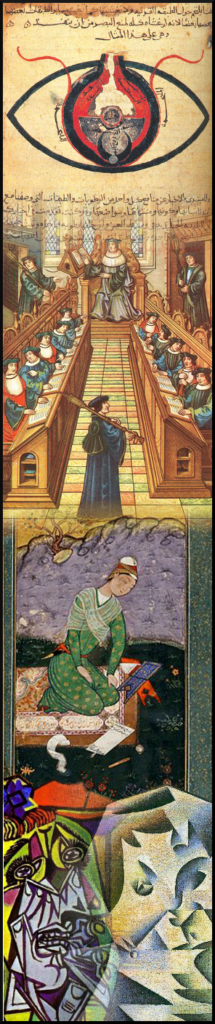
Vibrant dialogues about suppressed epistemologies and non-eurocentric archival materials have emerged in recent decades. At the same time, recent scholarship in world history has drawn renewed attention to the ancient and medieval periods. Many scholars now argue that modern economic world-systems built on the foundations of earlier world-systems and that later empires expanded the technologies, translation projects, and uneven core-periphery formations of ancient and especially medieval states and empires. This research has begun to rewrite long-standing eurocentric histories of geopolitical economy and culture, casting further doubt on the usefulness of terms such as “modernity” and “pre-modern.” Together, this emergent work sheds fresh light on the longer dialectics of struggle and creative transformation within and across world regions. In turn, such reconstellations have potential to transform research and teaching in Higher Education, to deepen understanding of global problems, and to foster new alliances among activist and academic communities.
The World Studies Interdisciplinary Project aims to activate a focused dialogue about these materials and thereby to foster cutting-edge interdisciplinary work in global and postcolonial/decolonial and intersectional-feminist studies. Working within a long-historical perspective, we are committed to the decolonizing of theory and disciplinarity as part of the project of decolonizing the material world and the human imagination. Organized collectively by faculty in the Humanities and Social Sciences at UMass-Amherst, our events support collaborative thinking about new paradigms, methods, data, pedagogy, and concepts in interdisciplinary global and longue durée studies.
WSIP events at UMass-Amherst have been supported or funded by the UMass-Amherst Interdisciplinary Institute (ISI), the offices of the Graduate School and the Vice Chancellor for Research and Engagement, and the deans and several departments of HFA and SBS.
Decolonial Global Studies Graduate Certificate
The WSIP Decolonial Global Studies Certificate is in the process of being reviewed by the faculty senate. However, courses that will count towards the certificate are being offered from Fall 2023 onwards. Click here for information on courses and registration. More information on the background and principles of the certificate can be found here. The DGS certificate welcomes graduate students from all disciplines and students are encouraged to apply after for admission to the certificate program after completing two courses.
WSIP Grad Workshop
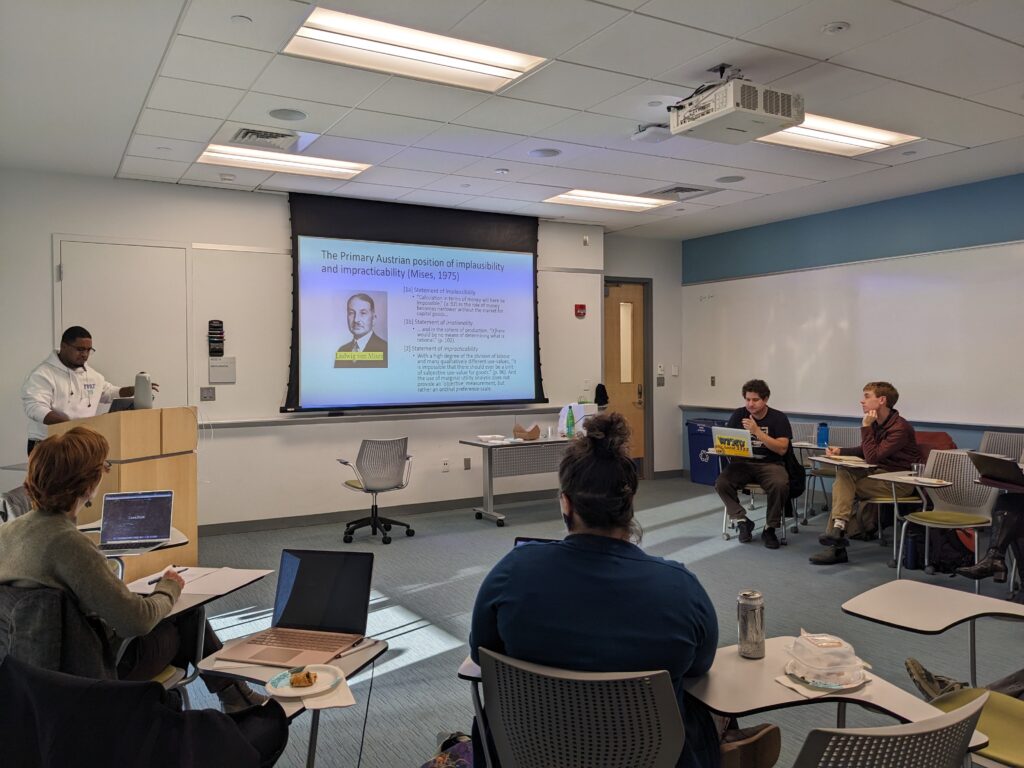
The workshop typically meets four times and semester. It provides a platform for students across disciplines to share their work, learn from one another, and center interdisciplinary thinking. Most graduate participants pursue anti-, post-, and/or de-colonial work. Click here for more information
Decolonial Global Studies Mellon Fellowships
The 2022-2025 Decolonial Global Studies Mellon Fellowships were awarded to faculty and graduate students to support interdisciplinary research and to develop the Decolonial Global Studies Graduate Certificate Program. The latter group included full year fellowships as well as summer dissertation fellowships. In addition, partnering with international community-based organizations, the WSIP program has also offered liaison fellowships to graduate students building networks beyond academic spaces
WSIP Mellon Visiting Fellows
WSIP continues to host several Mellon Visiting Fellows each semester for conversations and workshops engaging with decoloniality and interdisciplinarity. Visitors include academics, activists, and public figures. More information on past and upcoming visiting fellows can be found in the “events” section.